What’s OT Got to Do With It?
Feb 26, 2026How Occupational Therapy Supports Women’s Wellbeing
I know, I know… OT makes you think of disability, wheelchairs, or hospitals. And don’t get me wrong, all of this is important work that OTs do. But it’s not the full picture of what OTs can do. My mum, on the other hand? She’s convinced I actually work in IT. Which breaks my heart just a little. (Sigh.)
OTs have always moved like silent ninjas in allied health. Often showing up, making a difference, and vanishing without a trace. And where do we show up when no one’s looking? Some of the lesser-known settings where you’ll find us in our natural habitat include mental health services, hand therapy clinics, corporate workplaces… and yes, even prisons. And before you ask: we’re not serving time! Well, not that I know of - we’re there supporting mental health.
But what do we actually do?
Ah, I’m glad you asked.
In short… everything.
Let me break it down for you.
OTs help people unlock doors to the things they want to do, need to do, or are expected to do.
Confused yet? Don’t worry. Most people are.
Here’s the less mysterious version.
Occupational Therapy isn’t about your job (although yes, we can help with that too.) The word occupation simply means the things that occupy your time. The everyday stuff. The invisible stuff. The meaningful stuff.
Getting out of bed.
Parenting on three hours of sleep.
Returning to work after burnout.
Managing anxiety in a meeting.
Learning to use your hand again after surgery.
Rebuilding life after trauma.
If it matters to you, it matters to us.
OT is about function but not in a cold, clinical way. It’s about helping people participate in their own lives. When illness, disability, stress, grief, or life transitions throw a spanner in the works, we step in and ask:
What’s getting in the way?
What strengths are already here?
And how do we bridge the gap?
Unlike our wonderful physio cousins (who will absolutely get you moving beautifully), or psychologists (who help you understand your thoughts and emotions), OTs sit in the messy middle!
We look at the whole picture:
Your body.
Your mind.
Your environment.
Your roles.
Your routines.
Your culture.
Your real life.
We are practical dreamers. Strategic problem-solvers. Professional pattern noticers.
And yes… sometimes quiet ninjas.
Because the real magic of OT isn’t flashy. It’s the mum who can shower independently again. The executive who can manage panic before presentations. The teen who finds a way back to school. The older adult who keeps cooking Sunday lunch.
It’s not about fixing people.
It’s about helping people do life.
So What’s OT Got to Do With Wellbeing?
Again, everything.
Because wellbeing isn’t just bubble baths and deep breaths (although I fully support both). It’s about whether your days feel manageable long term. Whether your nervous system gets moments of rest. Whether your life reflects what truly matters to you.
In the wellbeing space, I don’t provide one-on-one therapy.
I build practical tools grounded in Occupational Therapy to support women in resetting their own lives.
Because here’s what I’ve observed:
As women, we don’t lack intelligence.
We don’t lack motivation.
We don’t lack insight.
What we often lack are tools that fit inside the reality of our lives.
And this is where OT shines.
Instead of asking, “What’s wrong?”
We ask, “What’s happening in your day?”
Where are the pressure points?
What routines are draining you?
What environments are overstimulating you?
What expectations are quietly exhausting you?
Occupational Therapy looks at habits, roles, energy, sensory load, mental load, and the invisible systems shaping daily life. And from that lens, we design resets.
Not dramatic overhauls.
Not aesthetic morning routines that require 4:30am wake-ups.
Not inspirational quotes slapped on top of burnout.
Real-life resets.
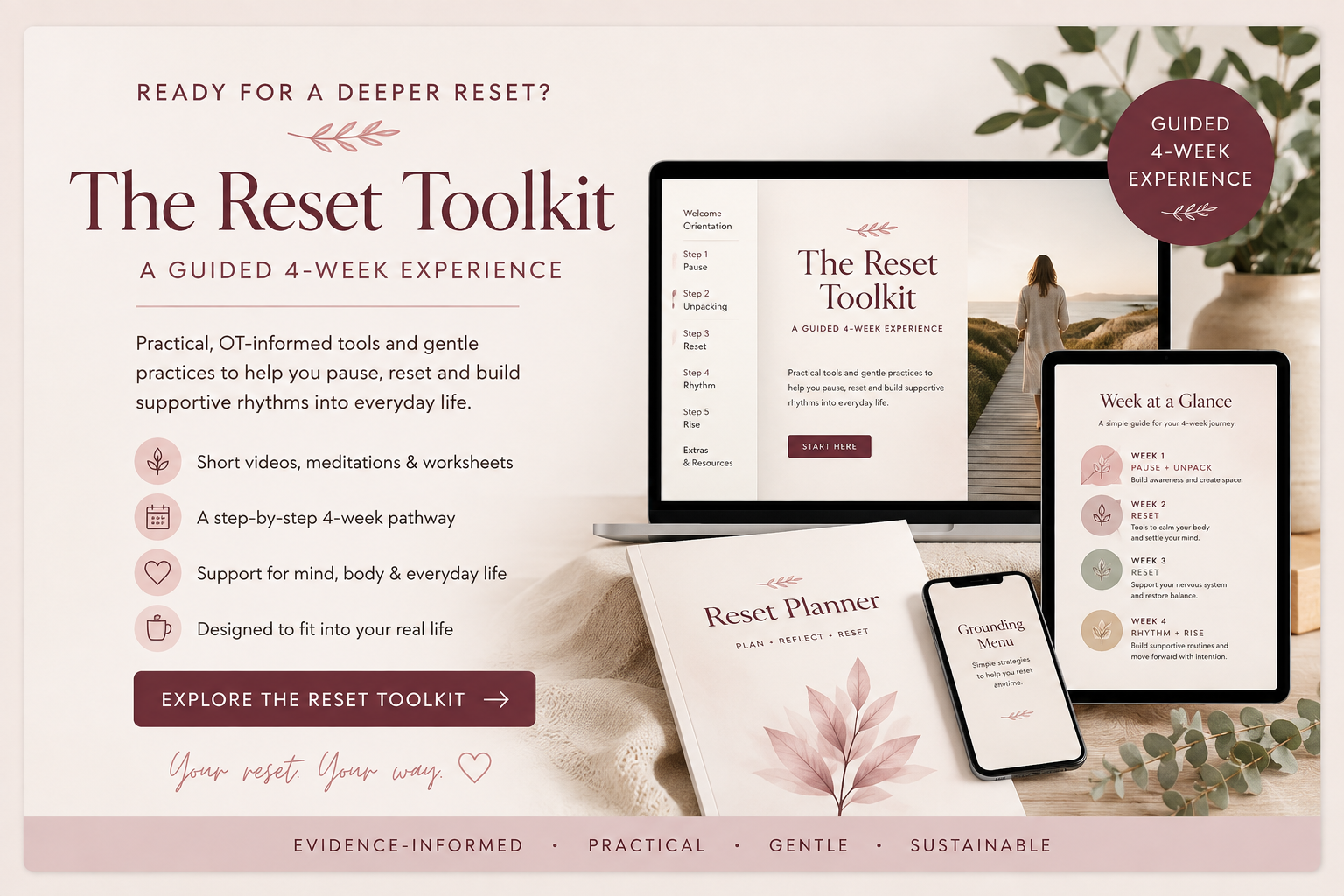
That’s why I created the Reset Toolkit and the Reset Planners. I offer structured, practical wellbeing tools designed to help women regulate, reflect, recalibrate, and return to themselves.
They’re grounded in OT principles:
Whole-person.
Environment-aware.
Function-focused.
Sustainable.
Because you don’t need more information.
You need tools that work inside the life you already have.
So yes… OT might be the quiet ninja of the allied health world.
But when it comes to wellbeing?
We’ve been designing the blueprint all along.
This is the work behind the Reset Toolkit and planners. These are structured wellbeing tools designed to support sustainable change, not surface-level fixes.
Ready to begin your reset?
Begin with my FREE Mini Reset.
Ready to go deeper? Explore the Reset Toolkit.