This Is OT: Why We Belong in the Wellness Conversation
Mar 29, 2026
Ah, to be a wellness ninja…
OTs are incredible at helping people, but when it comes to explaining our value? Not so much.
Most people don’t realise that OT has anything to do with mental health.
Or wellness.
Or burnout.
And I get it.
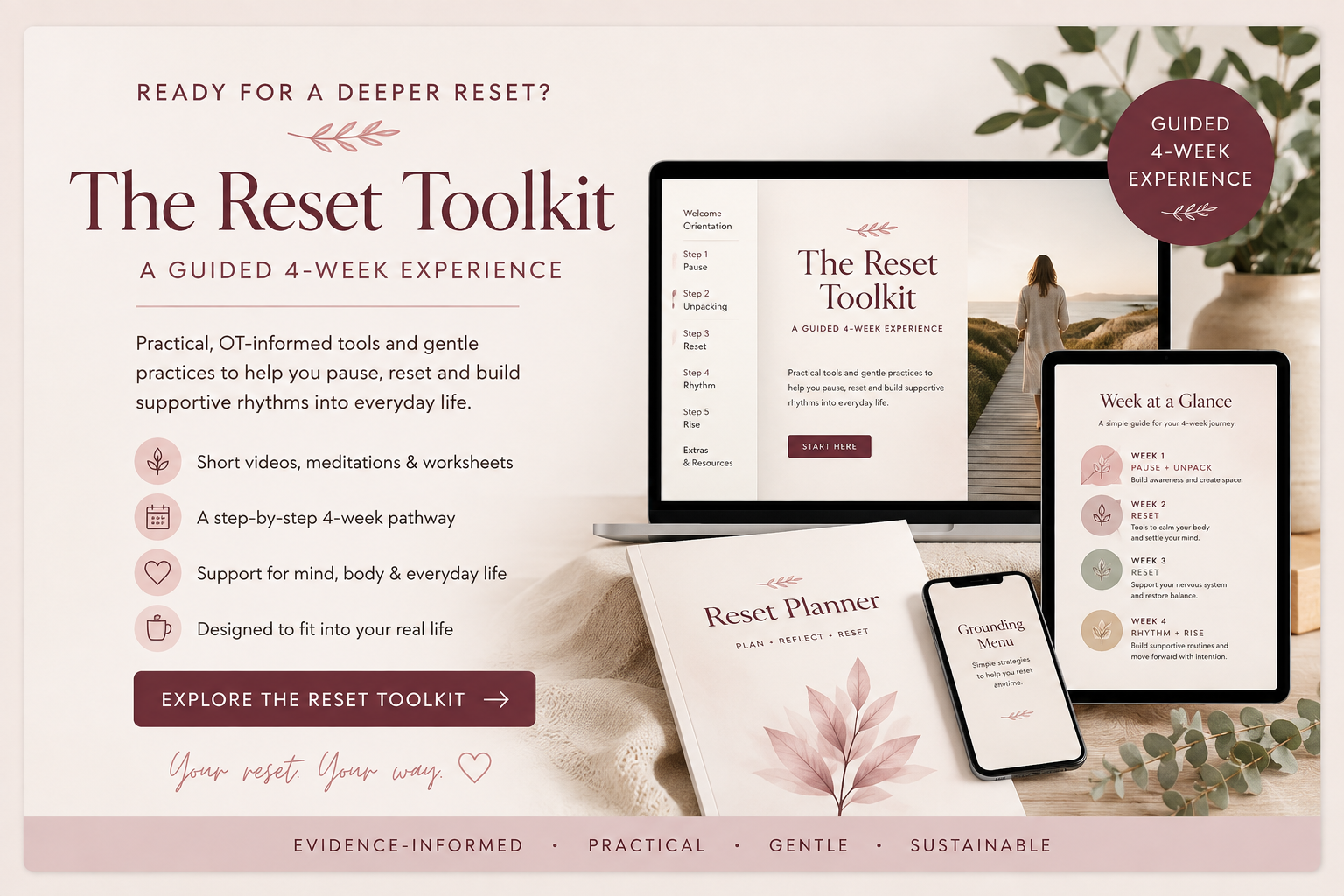
Because if you looked at something like my Reset Toolkit, you might think..
“Cool… but what does OT have to do with this?”
So let me show you.
Meet Rachel
She’s in her mid-30s.
A mum of three.
Recently divorced.
Working full-time in a job that used to feel manageable, but now feels like too much.
She’s constantly holding everything together.
The school lunches.
The emails.
The life admin.
The quiet worry about what comes next.
She’s exhausted… but she can’t seem to stop.
At night, when everything finally goes quiet, her brain doesn’t.
When she first hears about the Reset Toolkit, she’s skeptical.
"Is this just a lot of woo-woo?" she thinks.
But despite her doubts, she’s willing to try, because she knows something needs to change. It has to..
Step 1
The Pause: Understanding Life Transitions Through an OT Lens
We don’t start with fixing.
We start with a pause.
For the first time in a long time, Rachel is invited to slow down and actually look at where she is and not just what she has to do next.
She begins to understand that what she’s feeling isn’t failure…
it’s transition.
Through simple reflection tools (the kind we use in OT to understand a person’s life as a whole), she maps out everything she’s carrying (emotionally, mentally, practically).
And something shifts.
She realises:
No wonder this feels hard.
Step 2
The Unpacking: Releasing the Mental Load
It’s not just the visible tasks that are exhausting her. It’s the invisible load.
The constant thinking.
Planning.
Remembering.
Holding everyone else’s needs in her mind.
She begins to notice how much she’s been carrying, without ever putting it down.
Through gentle reflection and guided supports, she reconnects with small moments of rest, of quiet, of herself.
Not in a big, life-changing way.
But in small pockets that start to feel like space.
Step 3
The Reset: Nervous System Foundations for Calm and Clarity
Rachel has been living in a constant state of “go.”
Her body is wired, alert, always anticipating the next demand.
No amount of planning or motivation can override that.
So she learns how her nervous system works.
Why she feels the way she does.
She starts using simple tools:
- breathing differently
- releasing tension in her body
- using sensory strategies to ground herself
At first, it feels small.
But over time, she notices:
- she’s not snapping as quickly
- she can think more clearly
- she has a little more capacity
Step 4
The Rhythm: Creating Supportive Daily Rhythms
From there, we gently rebuild her days.
Not with strict routines that fall apart by Wednesday…With rhythms that actually fit her life.
She starts to map her time and energy.
She realises when she’s most depleted and when she has more to give.
She builds in small, realistic habits that support her instead of draining her.
- A better wind-down at night
- Moments of pause during the day
- Systems that help her remember, instead of relying on her already overloaded brain
It’s not perfect. But it’s sustainable.
Step 5
The Rise: Moving Forward With Clarity and Intention
Then something really important happens.
She stops just getting through the day and starts thinking about what she actually wants.
What matters to her now.
What kind of life she wants to build moving forward.
She creates a plan, not a rigid one, but something that reflects her values, her capacity, her reality.
And she keeps going, supported, not alone.
Her life hasn’t magically become easier.
She still has three kids.
A job.
A full life.
But she’s different in it.
She has tools.
She has awareness.
She has space to respond instead of react.
This is OT
This is OT. And it belongs in the conversation around wellness.
It’s not just “self-care.”
It’s not just breathing exercises.
It’s understanding a person’s life, their roles, their environment, their nervous system and helping them rebuild it in a way that actually works.
If you’re reading this and thinking… this feels a bit like me..
This is exactly the work we do inside Mayari Mind.
A space to pause, reset, and rebuild in a way that actually fits your life.
Ready to begin your reset?
Begin with my FREE Mini Reset.
Ready to go deeper? Explore the Reset Toolkit.