NSDR. Wise or Woo-Woo?
Jul 11, 2026
An Occupational Therapist's take on one of the biggest wellbeing trends.
Every few months, a new wellness trend promises to help us feel calmer, healthier or more productive.
Ice baths.
Infrared saunas.
Red light therapy.
Breathwork.
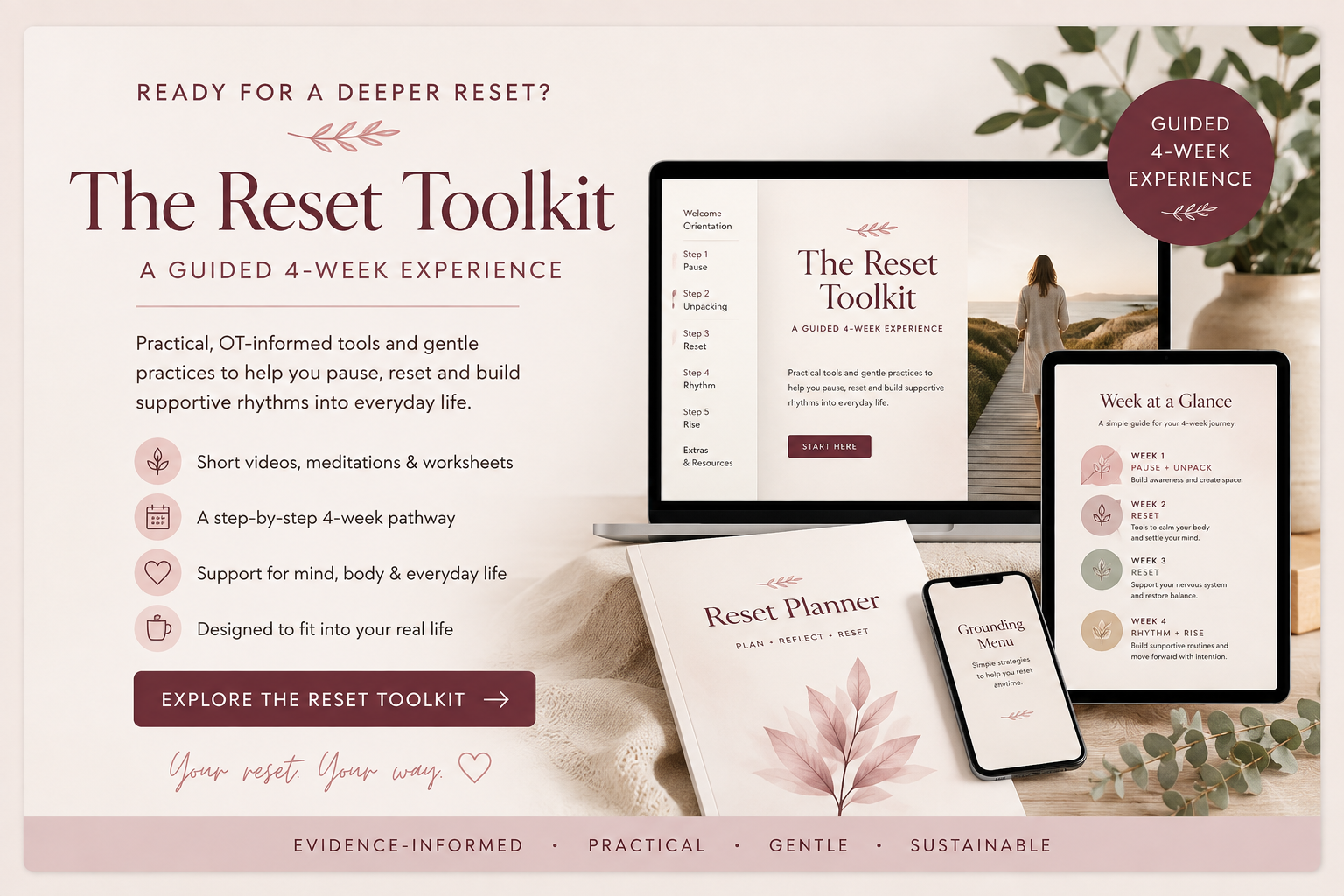
And yes... even my own Reset Toolkit. (A little shameless self-promotion never hurt anyone.)
Some wellness practices become overnight sensations before quietly disappearing a few months later. Others stick around because there's something genuinely helpful behind them.
One of the biggest wellbeing trends right now is NSDR.
So...
Is it wise? Or woo-woo?
Let's unpack it.
NSDR... What Now?
NSDR stands for Non-Sleep Deep Rest.
It's a guided practice designed to help your mind and body enter a state of deep rest while remaining awake. Think of it as intentionally creating space for your brain and nervous system to recover without needing to fall asleep.
While the term NSDR has become widely recognised through the work of neuroscientist Andrew Huberman, many NSDR practices draw on established approaches such as Yoga Nidra and other guided deep rest techniques.
Rather than being a completely new practice, NSDR brings together well-established principles of guided rest in a way that's become accessible to a wider audience.
Today, NSDR is increasingly being explored as a practical way to recover from mental fatigue, support nervous system regulation and create intentional moments of rest in busy lives.
Why Has Everyone Started Talking About It?
There's good reason.
Many people are feeling...
- mentally overloaded
- constantly connected
- wired but exhausted
- struggling to switch off
NSDR offers something surprisingly simple.
Permission to stop.
Not to be productive.
Not to optimise yourself.
Just to rest.
What Are the Potential Benefits?
Research into NSDR and related deep rest practices suggests they may help support:
- A calmer nervous system
- Slower breathing and heart rate
- Reduced mental fatigue
- Improved focus after resting
- Recovery from stressful or mentally demanding days
Like many wellbeing practices, it's not a cure-all.
But for many people, it can become a valuable tool within a broader wellbeing routine.
The Occupational Therapy Perspective
Here's where I think NSDR becomes really interesting.
As Occupational Therapists, we don't just ask,
"Does this work?"
We ask,
"How does this fit into everyday life?"
Because even the most evidence-informed strategy won't help if it's unrealistic to maintain.
Rather than treating NSDR as another task to squeeze into an already busy schedule, I prefer to think about it as part of an occupational transition.
For example:
- after work before making dinner
- during a lunch break
- before caring for others
- after a mentally demanding day
- before moving into your evening
Instead of adding another thing to your to-do list, you're creating a gentle bridge between one part of your day and the next.
That's much more sustainable.
Because the best wellbeing strategies aren't the ones we do once, they're the ones that become part of everyday life.
So... Should You Try It?
If you're someone who finishes the day feeling mentally switched on but physically exhausted...
If you find it difficult to transition from work into the rest of your evening...
Or if you're simply looking for a practical way to create space before moving on to the next part of your day...
NSDR may be worth exploring.
As an Occupational Therapist, I don't see NSDR as another wellness trend to add to your list.
I see it as one practical way to create intentional transitions between the occupations that make up everyday life.
Wise or Woo-Woo?
For me...
Definitely more wise than woo-woo.
Not because it's magical.
Not because it's trendy.
But because intentional rest has always mattered.
NSDR simply gives us another practical way to build that rest into modern life.
And like most wellbeing strategies, the magic isn't in doing it once.
It's in making it part of a routine you can actually sustain.
Want to Experience It?
I've created a free After Work NSDR Reset designed to help you transition from your workday into the rest of your evening.
It's an occupation-based NSDR, grounded in occupational therapy principles and designed to fit into real life.
If it helps you, save it for the days you need it most.
And if someone comes to mind while you're reading this, consider sharing it with them.
Further Reading
If you'd like to explore more about NSDR and the research behind deep rest, these resources provide additional background.
- Andrew Huberman's NSDR resources
Huberman Lab – Non-Sleep Deep Rest (NSDR)
- Information on Yoga Nidra and guided deep rest practices
The Science and soul of rest: How Yoga Nidra and Non-Sleep Deep Rest (NSDR) Support Deep Healing
Note: While research into NSDR and related practices is promising, responses vary from person to person. This article is intended for educational purposes and should not replace personalised medical or mental health advice.
Ready to begin your reset?
Begin with my FREE Mini Reset.
Ready to go deeper? Explore the Reset Toolkit.