What My Sausage Dog Taught Me About the Vagus Nerve
Feb 28, 2026
The vagus what now?
You’ve probably heard health professionals bang on about the vagus nerve. Your eyes glaze over. You’re mentally planning what you’re going to watch on Netflix tonight..
I promise, we’re not trying to torture you with clinical jargon or sprinkle in something woo-woo for fun (lol).
We talk about the vagus nerve because we want to connect you with strategies that actually help. But first comes the why.
We want you to understand how your body handles stress.
Because when you understand what’s happening inside your nervous system, you stop blaming yourself. You gain language. You gain clarity. You gain power and agency.
And that changes everything.
Meet Alfie
Now, understanding stress in theory is one thing, but watching it in action is another.
Enter Alfie, my adorable sausage dog. My unofficial regulation dog. An unpaid role, of course, until dogs form unions. Sorry, Alfie…
Right now, he’s living his best life. He is sprawled out on the rug by my feet, full from a chicken wing, snoring softly, completely content. His body is loose and relaxed. His breathing is slow. He is safe.
This is Alfie in a regulated state.
His nervous system isn’t scanning for danger. It isn’t preparing to run. It isn’t shutting down. It’s calm, connected, and at ease.
That calm, connected state?
That’s where the vagus nerve plays an important role.
The vagus nerve is a long nerve that runs from your brainstem down through your chest and abdomen. Think of it as a communication highway between your brain and your body.
It’s part of your parasympathetic nervous system, the branch responsible for rest, digestion, and repair.
When your vagus nerve is active, it helps slow your heart rate, deepen your breathing, support digestion, and create that internal felt sense of safety.
When it’s less active, your system is more likely to stay in fight, flight, or shutdown.
So when we talk about supporting your vagus nerve, we’re not talking about something mystical.
We’re talking about supporting your body’s built-in safety system.
When the Postie Arrives
Now let’s say the postie pulls up outside.
Alfie’s ears prick up before I even hear the van.
The snoring stops.
His body stiffens.
Within seconds, he’s racing to the door, barking like he’s personally responsible for national security.
Alfie’s heart is racing.
Pupils dilated.
Muscles engaged.
Adrenaline surging.
This isn’t bad behaviour.
This isn’t drama.
This is biology.
Alfie has moved into a fight-or-flight state.
His body didn’t ask permission.
It didn’t consult logic.
It didn’t remember that the postie has been delivering mail safely for years.
It reacted.
Your nervous system does the same.
And Sometimes… Shutdown
Now imagine Alfie at the vet.
Too many smells..
Too many sounds..
Held still on a cold metal table.
Sometimes, instead of barking, he goes very quiet.
Still.
Withdrawn.
This isn’t calm.
It’s another protective response. When the nervous system decides fight or flight won’t work, it can shift into shutdown.
Low energy.
Heavy body.
Disconnected.
Again, this is not weakness.
Not personality.
Biology.
The Difference Between Alfie and Us
When the postie leaves, Alfie shakes it off. Literally.
He does a full-body wiggle.
Sniffs the garden.
Returns to the rug to continue his snooze-fest..
Back to baseline.
His stress response completes.
We don’t always complete ours.
Instead, we stay half-switched-on.
Half-braced.
Half-alert.
Mind racing.
Emails become the postie.
Meetings become the vet table.
Mental load becomes the constant scanning for threat.
Over time, that unfinished stress response becomes exhaustion.
Why the Vagus Nerve Matters
The vagus nerve plays a key role in helping your body return to safety. It influences breathing, heart rate, digestion, and that felt sense of “I’m okay.”
Understanding this isn’t about becoming a neuroscience expert.
It’s about recognising:
- You are not overreacting.
- You are not broken.
- Your body is trying to protect you.
And when you understand that, you stop fighting yourself. You start supporting your nervous system instead.
Three Simple Ways to Support Your Vagus Nerve
Alfie naturally completes his stress cycles.
We often need a little help.
Here are three practical, grounded ways to support regulation - no cold plunges required!
1. Lengthen Your Exhale
Your vagus nerve responds to slow, controlled breathing, especially a longer exhale.
Try this:
Inhale for 4.
Exhale for 6.
Gentle. Unforced. Steady.
A longer exhale signals to your nervous system:
It’s safe to soften.
2. Complete the Stress Cycle
Notice how Alfie shakes after he barks?
That’s his body discharging activation.
We often hold ours in.
Try:
- A brisk walk or light jog
- Shaking out your arms for 30 seconds
- Rolling your shoulders slowly, forward and back
- A 5-minute gentle stretch routine on YouTube
Movement tells your body the “threat” has passed.
3. Create Micro-Moments of Safety
Regulation isn’t just calming down. It’s creating safety cues.
That might look like:
- Warm tea in your favourite mug
- Five minutes in the sun
- Gentle music
- A hand resting on your chest
Tiny, repeated cues of safety help your nervous system return to baseline.
Final Reflection
Alfie resets throughout his day without thinking about it.
His body knows how to return to safety.
We don’t always have that luxury.
Our stressors aren’t a passing postie.
They’re ongoing.
Emails. Expectations. Mental load. Invisible responsibility.
So while Alfie can shake it off and move on, we often need something more intentional.
More structured.
More repeatable.
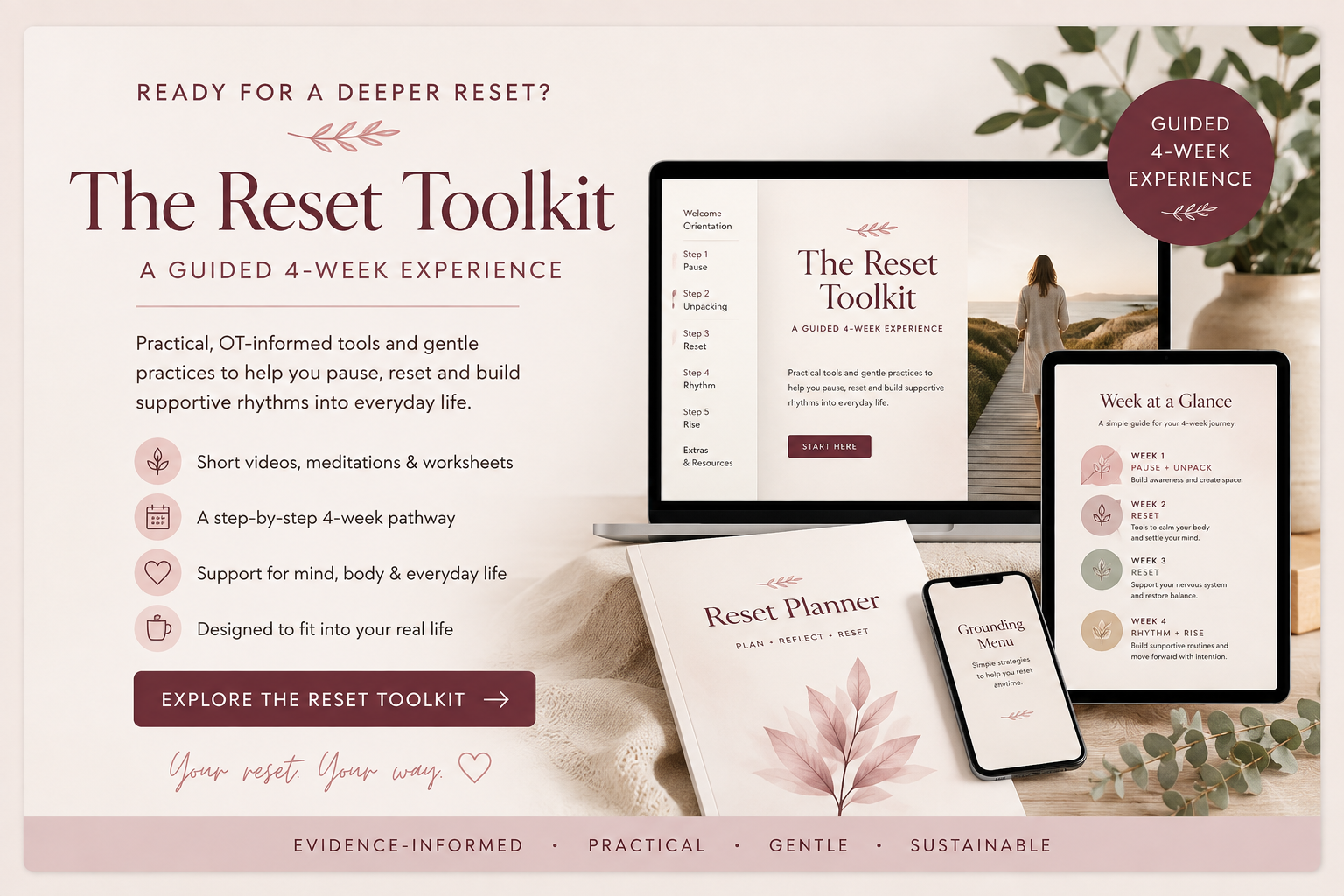
This is the work behind the Reset Toolkit and planners. They are practical, Occupational Therapy-informed tools designed to help your nervous system return to safety in real life.
Not dramatic overhauls.
Not aesthetic morning routines that require 4:30am wake-ups.
Structured, sustainable resets that fit inside the life you already have.
Because understanding your nervous system gives you awareness.
But having tools? Now, that’s what gives you agency.
Ready to begin your reset?
Begin with my FREE Mini Reset.
Ready to go deeper? Explore the Reset Toolkit.