The Big M: Menopause & Transition
Aug 29, 2026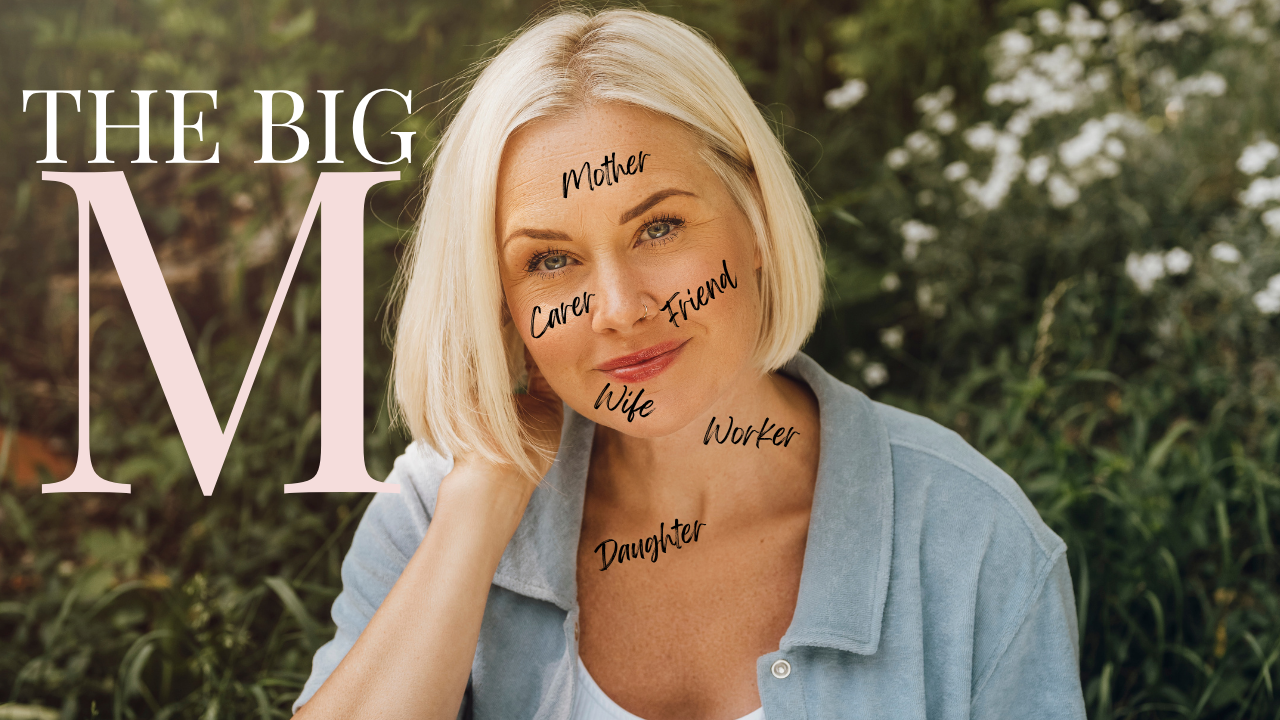
Welcome to The Big M!
Batten down the hatches, ladies. You're in for a rocky ride!
Or at least, that's sometimes how menopause can feel when you start reading about it. And let's face it, it can read like a bit of a horror story.
Hot flushes. Brain fog. Sleepless nights. Anxiety. Mood changes. Fatigue.
It certainly doesn't sound like a spa vacay!
And yes, the symptoms of perimenopause and menopause are real. They can be incredibly disruptive and deserve appropriate support.
But there's another part of menopause that we don't talk about nearly enough.
Menopause is a significant life transition.
And transitions don't just affect our bodies. They can affect the way we work, the roles we hold, the routines that structure our days, our relationships, our confidence and sometimes even our sense of who we are.
Maybe menopause isn't just about weathering the storm. Maybe there's something deeper happening as we adjust to this new stage of life.
That's the part of menopause I want to talk about.
So let's go there!
When something has shifted, but life hasn't
There can be a strange moment in midlife when the life you've been managing for years suddenly feels harder to manage.
You're still going to work, caring for family, remembering appointments, organising meals, maintaining relationships and keeping all the usual plates spinning.
But something feels different.
Perhaps you're waking at 3am and struggling through the next day. Your energy isn't as predictable as it once was. You walk into a room and forget why you're there. Concentrating takes more effort. You're more easily overwhelmed. The exercise you used to enjoy feels harder to fit in and by the end of the day you have very little left to give.
And yet, life hasn't necessarily slowed down to accommodate any of it.
Something has shifted. You can feel it, even if the people around you can't see it. And somehow, you're still expected to keep showing up as the person you've always been.
Menopause isn't just change. It's transition.
There's a model of transition developed by William Bridges (2009) that I think provides an interesting lens through which to look at menopause. While Bridges' model was not developed specifically for menopause, it provides a useful framework for considering the internal process of adapting to this significant life transition.
Bridges made an important distinction between change and transition.
Change is what happens.
Transition is the internal process we go through as we adjust to that change.
He described three phases of transition:
- Endings
- Neutral Zone
- New Beginnings
Of course, women's experiences of menopause don't fit neatly into three boxes. Transition isn't necessarily linear and every woman's experience will be different.
But the model gives us an interesting way to think about something that can be overlooked in conversations about menopause:
When something significant changes in our lives, we may also need to adjust to who we are within that change.
Phase One: Ending, Losing and Letting Go
The first phase of Bridges' model is about recognising that for something new to begin, something else is changing or coming to an end.
In menopause, there is the obvious biological ending of the reproductive stage of life.
For some women, that may carry enormous significance. For others, very little.
But there can be other, less obvious endings too.
Perhaps it's the end of predictable periods or knowing what to expect from your body each month.
Perhaps the morning routine you've followed for years no longer works after another night of disrupted sleep.
Maybe you've always been able to push through a demanding week and recover on the weekend, but your energy doesn't seem to work that way anymore.
Perhaps you've always thought of yourself as organised, capable and able to juggle ten things at once and suddenly you're struggling to remember why you walked into a room.
Or maybe it's not the role itself that's changing.
It's the way you've always been able to perform that role.
That can be unsettling.
Because our roles aren't simply things we do. They can become deeply connected to how we see ourselves.
Professional.
Partner.
Mother.
Daughter.
Friend.
Carer.
Runner.
Organiser.
The person who remembers everything.
The person everyone relies on.
When our capacity to participate in those roles changes, it can affect our sense of identity too.
And sometimes that can leave us asking: What's happening to me?
Phase Two: The Neutral Zone
This is perhaps the most interesting part of Bridges' model when we apply it to menopause.
The Neutral Zone is the space between the old and the new.
The old way doesn't quite fit anymore.
But you haven't yet worked out what the new way looks like.
It's the messy middle!
And menopause can feel a lot like that.
You haven't stopped being you.
You're still going to work. Still answering emails. Still caring for people. Still making decisions. Still managing the household. Still showing up.
The washing certainly hasn't disappeared (I wish).
But internally, things can feel very different.
Sleep. What sleep?
Energy is plummeting as with your labido.
Your concentration may be different.
Your emotions may feel different.
Your body may feel different.
And the routines and strategies that have helped you manage your life for years may suddenly not work quite as well as they used to.
The world around you may not have changed very much at all, while your experience of participating in it has.
That's a very difficult place to be.
Because if everyone around you still sees the same woman they've always known, there can be an expectation that you will continue functioning in exactly the same way.
Sometimes, we expect that of ourselves too.
Same workload.
Same responsibilities.
Same routines.
Same pace.
Same expectations.
And when that becomes harder, it's very easy to turn the frustration inwards.
Why can't I cope with this anymore?
Why am I finding everything so difficult?
Why don't I feel like myself?
But perhaps the question isn't:
“How do I get back to how I was?”
Perhaps it's:
“What do I need now?”
When roles and identity start to shift
This is where my occupational therapy brain becomes particularly interested.
Occupational therapists use the word occupation to describe the everyday activities we need, want and are expected to do.
Working. Parenting. Caring. Sleeping. Exercising. Cooking. Socialising. Resting. Managing a household. Maintaining relationships. Participating in hobbies and doing the things that give us meaning and purpose (Khan, 2025).
Those everyday occupations also help shape our roles and identity.
So when menopause begins affecting our ability to participate in them, the impact can extend far beyond the symptom itself.
Poor sleep isn't only poor sleep if it means you're struggling to concentrate at work the following day.
Fatigue isn't only fatigue if you've stopped doing the Saturday morning walks you've loved for years.
Brain fog isn't simply forgetting a word if it starts making you question your professional competence.
Feeling overwhelmed isn't just an unpleasant feeling if you're beginning to withdraw from people or activities that matter to you.
Now, you might be thinking, “Fi, give me some good news here!”
I hear you.
Because transition isn't only about what we're leaving behind or the uncertainty of the messy middle.
There's also what comes next.
And that brings us to the final phase of Bridges' model.
Phase Three: New Beginnings
And no, I'm not going to tell you that menopause is the beginning of a fabulous new you.
Sometimes difficult things are simply difficult.
But a new beginning doesn't have to mean completely reinventing yourself.
It can mean beginning to understand what works for you now.
Maybe some expectations need to change.
Maybe responsibilities need to be renegotiated.
Perhaps routines need to evolve.
Maybe you need more recovery than you once did.
Perhaps something you've spent years doing because you felt you should doesn't feel particularly important anymore.
And perhaps there are things that once mattered deeply to you that have quietly disappeared beneath work, family and responsibility.
Transitions can create an opportunity to ask:
What matters to me now?
What do I want to keep?
What am I ready to let go of?
What do I want more of?
Which roles still feel important?
What supports the person I am now?
The answers might not be the same as they were ten or twenty years ago.
And perhaps they don't need to be.
Maybe the goal isn't getting the old you back
There's a phrase we hear a lot in women's wellbeing:
“I just want to feel like myself again.”
I get it.
When your body, energy, emotions or capacity feel unfamiliar, of course you can long for the version of yourself that felt easier to inhabit.
But Bridges' model offers another possibility.
Perhaps navigating transition isn't necessarily about returning to where you were.
It's about acknowledging what has changed, allowing some things to be left behind and gradually discovering what fits the next stage.
That might involve changing how you participate in certain roles.
Creating different routines.
Asking for support.
Protecting your energy.
Rediscovering meaningful activities.
Reconsidering expectations you've carried for years.
Or simply giving yourself permission to do some things differently.
Not a completely new you.
Still you. Just navigating a new chapter.
The Big M
Menopause is a biological transition.
But it is lived through everyday life.
Through our roles.
Our routines.
Our relationships.
Our work.
Our energy.
The things we do.
The things we stop doing.
And sometimes through the quiet question of who we are becoming as life changes around us.
So yes, The Big M can feel like a rocky ride!
But perhaps we don't need to batten down the hatches.
Perhaps we need a better map.
by, Fiona Delahunty
Occupational Therapist & Founder, Mayari Mind
Looking for practical menopause support?
Explore my Menopause YouTube Playlist, with guided practices and practical tools designed to support rest, regulation and wellbeing through perimenopause and menopause.
Ready for a small reset?
My Free Mini Reset includes three simple, OT-informed resources you can use in everyday life, including a guided breathing practice, After Work NSDR and a Wellbeing Anchor workbook.
Fiona Delahunty is an Occupational Therapist and founder of Mayari Mind. Mayari Mind provides practical, evidence-informed wellbeing resources designed to support women through stress, overwhelm and life transitions.
This article provides general educational information and is not a substitute for individual medical or healthcare advice. If you are experiencing symptoms associated with perimenopause or menopause, speak with an appropriately qualified healthcare professional.
References
Bridges, W. (2009). Managing Transitions: Making the Most of Change (3rd ed.). Da Capo Press.
Khan, S. (2025). Occupational therapy and women's health: A practitioner guide. Routledge.
Ready to begin your reset?
Begin with my FREE Mini Reset.
Ready to go deeper? Explore the Reset Toolkit.